What if your nonprofit could stop worrying about sporadic donations and start building a foundation of reliable, recurring gifts? Monthly giving programs provide exactly that: predictable revenue streams so you can plan confidently and make a lasting impact.
A strong base of monthly supporters makes executing your nonprofit’s strategic plan and achieving long-term goals easy. For donors, becoming monthly supporters goes beyond convenience. It’s a meaningful way to stay connected with a cause they care about.
Notably, donor retention rates for monthly giving programs average over 80% after a donor’s first year, while new donor retention rates average around 20%. To help boost retention rates and grow your nonprofit, we’ll explore four strategies to convert one-time supporters into loyal monthly donors:
Your first step is to research your donors. Data within your nonprofit's CRM can reveal why specific donors give to your organization and how you can inspire them to give consistently. Discover which one-time donors are most likely to convert to monthly giving by looking at their:
To streamline your research, you’ll need a CRM with up-to-date, clean donor data. Your technology will streamline the process of organizing donor data into profiles and analyzing giving patterns across campaigns, events, and day-to-day giving. This approach helps uncover insights that signal a donor’s readiness to commit to monthly giving, allowing your nonprofit to engage them with targeted outreach.
Building meaningful relationships is essential before asking for a monthly gift. Trust develops through personalized touchpoints that make donors feel valued and connected to your cause.
Here are practical ways to cultivate these relationships:

This relationship-first approach builds trust, making donors more likely to commit to ongoing support. Thoughtful, personalized touchpoints demonstrate genuine appreciation for your supporters’ generosity and nurture long-term connections.
To earn monthly donors, lower as many barriers to participation as possible. Increase awareness of your recurring giving program by adding straightforward subscription options to your donation form. Include a checkbox or toggle button to choose between a one-time or recurring donation. From here, supporters should be able to select their preferred giving increment, such as weekly, monthly, or annually.
Add suggested donation amounts to guide users on how much to give and provide an idea of what each level of support will help accomplish. Also, make paying convenient by offering multiple payment methods, such as credit cards, ACH, and digital wallets like Apple Pay.
When emailing or texting donors about joining your program, include a link to a pre-filled form to streamline the process. Your CRM can store donor data and automatically populate the form fields through an integration with your donation form. Alternatively, generate unique links for donors with embedded query parameters (e.g., name, email, saved payment method). These personalized links reduce friction in the signup process, making it faster for donors to join.
From here, ensure donors can easily adjust or pause their monthly gifts online without contacting your team. Provide access to a donor portal where they can make adjustments and see their cumulative impact.
From here, it’s time to market your nonprofit’s recurring giving program. Show supporters the value of becoming monthly donors by creating enticing incentives, such as:
When crafting your donation appeals, emphasize these perks and explain the power of recurring gifts. Use clear, relatable examples like “Your $25 per month will supply a household with clean drinking water for a month.” This type of messaging helps donors visualize their support’s impact over time.
Storytelling also plays a vital role in persuading donors. Show how sustained support drives lasting change by sharing real-life stories of individuals who have benefited from continuous giving. Formatting testimonials as videos makes these messages even more appealing by putting a face and voice on your cause.
While your donation requests and appreciation messages should be sent separately, consider adding a short, heartfelt appeal within your thank-you letters. Weave your appeal subtly into your thank you letters, as eCardWidget suggests avoiding immediately asking for another donation. Otherwise, you risk overwhelming supporters and communicating that you don’t appreciate their initial gift.
After emphasizing the impact that their donation is making, introduce your program by including a few lines like the following:
"As we reflect on the impact of your gift, we wanted to share that one of the most powerful ways to sustain this work is through a recurring donation. Even a small monthly contribution can create lasting change, providing steady support for [specific program or goal].
There’s no pressure—this note is all about expressing our gratitude. However, if a recurring gift feels like the right fit, you can explore how the program works here: [Insert Link to Recurring Gift Page]."
This approach puts the ask on their radar without overwhelming them.
Donors want to make a difference, and nonprofits thrive when they can count on reliable support. Monthly giving offers both sides what they need: predictable revenue for nonprofits and an easy way for donors to give routinely.
By encouraging one-time donors to make regular contributions, your nonprofit can shift from reactive fundraising to proactive planning. Follow our advice to inspire more donors to join your monthly giving program.
Building a successful monthly giving program relies on streamlined processes and insightful donor data. The Andar/360 nonprofit CRM provides the tools needed to organize donor profiles, analyze giving patterns, and facilitate recurring donations with ease. From customizable donation forms to a donor portal for self-service management, Andar/360 helps nonprofits strengthen relationships and increase donor retention. Contact us to discover how these features can empower your organization to create lasting connections and a reliable revenue stream.
Your nonprofit exists to change your community for the better. Whether you’re part of a public hospital, a wildlife conservation group, or a food bank, you want nothing more than to expand your impact from one year to the next. However, accomplishing more doesn’t necessarily mean doing more. Be more effective in your fundraising and volunteer efforts with a nonprofit strategic plan
By developing a clear strategic plan for your nonprofit, you can ensure that your organization continues carrying out its mission without spreading itself too thin. Setting focused, measurable goals allows your team to make confident and data-driven decisions that align with your overarching purpose. In this guide, we’ll share some tips for crafting strategic goals and walk through common types you can include in your next strategic plan.
There is no definitive set of goals or priorities that your nonprofit needs to outline in its strategic plan. After all, every organization differs in terms of how it operates, which resources it has, and what it’s trying to achieve in the long term.
To design goals that are tailored specifically to your nonprofit’s situation and needs, start with these steps:
Review your past finances, key performance indicators (KPIs), major changes, and recent challenges. Then, take a look at similar organizations to get a better idea of how they run programs and what strategies they employ. Gathering this context can help you narrow down your priorities for the near future.
By reaching out to your staff, donors, volunteers, and other community members, you can factor their concerns and suggestions into your goal-setting. Laridae’s strategic planning guide recommends enlisting a third-party expert to conduct online surveys, focus groups, town hall meetings, and one-on-one interviews to allow for more open and honest communication from your stakeholders.
SMART goals are specific, measurable, achievable, relevant, and time-based. Your strategic plan’s goals should be clear and ambitious, but reasonable at the same time. By adding concrete deadlines, you ensure that your team can measure its progress along the way and make adjustments as needed to get the results you want.
Remember that unlocking truly actionable insights for your goal-setting requires having accurate and organized data to reference. Maintain data hygiene by using standard data entry formats across your nonprofit and auditing your database at least once a year to identify strategic improvements that take your impact to the next level.
Some common types of goals your nonprofit might include in its strategic plan are:
As time goes on, your nonprofit might spot more and more community needs cropping up in its focus area. As a result, your team may feel compelled to take on new initiatives or expand your programs beyond their original scope. While these activities can be a common part of any organization’s growth, you need to ensure that they’re all directly aligned with your mission.
Strategic planning provides an ideal opportunity for your leadership team and board members to re-examine your mission, vision, and values. In doing so, they can clarify whether your nonprofit’s current pursuits are aligned with the impact you’re trying to create and adapt your approach accordingly. For example, your team might decide that it needs to produce a new set of communication materials that articulate your mission and outline your desired outcomes more clearly.
Your nonprofit’s success depends on the involvement of an entire community—your staff, volunteers, donors, board members, and more. To get the word out about your cause and secure more long-term support, you might set goals to:
To assess your performance, keep track of metrics such as your outreach event attendance, social media followers, newsletter opt-ins, or website traffic.
To set your nonprofit up for long-term success and sustainability, you must establish a strong foundation with your staff and internal processes. If you’ve determined that you need to build capacity and increase efficiency in your organization, you might commit to:
As you put your strategic plan into action, you can use skill assessments and KPIs such as training completion rates or employee retention rates to determine whether your efforts are paying off.
For many nonprofits, their programs and services are some of the most direct ways for them to make a difference in the lives of those they serve. If this applies to your organization, you might use your strategic plan to plot out your next programmatic priorities, whether you want to launch a new program or enhance the quality of your existing services.
Your nonprofit, for example, could decide to put a new framework in place for evaluating the effectiveness of your programs using participant feedback and additional metrics. Or, you might determine that you need to reallocate your existing resources to make your services more accessible to people in your community.
The Communications Network has found that, over the past few years, racial diversity across nonprofit staff, senior leadership, and board members has been trending upward. Additionally, more organizations are beginning to speak out on current events and issues related to diversity, equity, and inclusion (DEI).
As DEI becomes more and more of a priority in the nonprofit sector, your organization might set goals related to implementing diverse hiring practices and providing inclusive training to staff members. You could also focus on improving access to your services by updating your website with accessibility best practices and adding multilingual support to your programs.
To maintain and expand your nonprofit’s impact, you need to ensure that your team always has the resources it needs to carry out its essential activities. To improve your financial health and develop more stable revenue streams to rely on, you might include some of the following goals in your strategic plan:
As you pursue new fundraising opportunities, keep an eye on metrics such as your fundraising return on investment (ROI) and the number of gifts secured to identify which strategies are resonating most with your donors.
By harnessing the power of your nonprofit’s community, you can accomplish more together. With this in mind, one of your strategic priorities might involve building mutually beneficial partnerships with local businesses and organizations. According to 360MatchPro, common types of support corporate partners could provide include:
When seeking these partnerships, be sure to find companies that have similar values to your nonprofit. Doing so ensures that you can both work toward a shared vision and goals, no matter what format the partnership takes.
Grant funding is critical for nonprofit growth. Along with planned and major gifts, grants provide a significant portion of the revenue your organization needs to complete large-scale projects, launch new programs, and develop a strong financial foundation for the future.
Finding grant opportunities that match your nonprofit’s needs takes time and effort. Submitting well-crafted applications also demands careful attention. However, Your work continues even after a grantmaker awards funding to your organization! You also have to manage the grant properly to make the most of it.
To help you get started, this guide will review four best practices for nonprofit grant management, including how to:
Besides helping your organization allocate grant funding internally, grant management is essential to comply with funder requirements. Grantmakers see grants as investments in good causes, so they want to know that the nonprofits they award funding to will handle it in the best possible way to further their missions. That being said, let’s dive in!
Since grant management has a reputation for being complex, it’s best to start considering your post-award activities as soon as you find a grant that aligns with your needs. If your organization isn’t currently equipped to manage it, you should either take the necessary steps to create a management system or look for other opportunities if that isn’t possible.
Jitasa, recommends developing a grant management system early for each opportunity. This approach lets your nonprofit address common challenges proactively. These include:
As you manage multiple grants, you'll have a solid foundation for recording and reporting. You can adjust this system as needed for each grant's specific requirements.
The biggest part of setting up a grant management system is choosing a software solution to centralize your process. Double the Donation’s nonprofit software guide recommends looking for the following features in your grant management platform:
Your nonprofit should also consider looking for a cloud-based solution. These platforms store your data on internet servers rather than on specific devices, allowing anyone at your organization to work on grant management from anywhere while still maintaining data security.
In addition to the features above, it’s helpful if your nonprofit’s grant management solution integrates with your accounting software. This way, you can more easily track the monetary progress of your grant for both funder reporting and internal financial management purposes.
However, grants aren’t all recorded the same way. There are three main types, each with its own process:
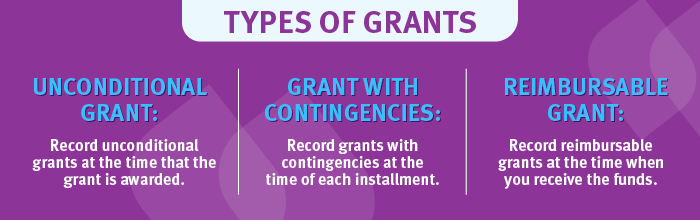
Unconditional grants, as their name implies, allow your organization to receive all of the funding at once and spend it at your discretion. To help you get a head start on financial planning, you should record an unconditional grant in full as soon as you’re notified that you’ve secured it, even if the money takes a few weeks to arrive.
Grants with contingencies are provided in installments as your nonprofit demonstrates to the grantmaker that you’re fulfilling the conditions they’ve specified. For example, if you’re using a grant to fund a community program, the funder might only agree to continue paying out the grant as long as you have at least 20 participants in the program. Since funding is less certain with these grants, record the first installment when you’re awarded the grant and each subsequent installment as you receive the funds.
Reimbursable grants require your organization to spend the money on an initiative up front before the funder pays back the costs you’ve incurred. You likely won’t know exactly how much the grant will be worth until the funding comes, so you should wait to record it until then. However, you should keep a detailed record of your grant-related expenditures to ensure you’re reimbursed for the correct amount.
When you apply for a grant, take note of which category it falls into so you know how to record the funding if and when it comes in. If the grant type is unclear or you have any other questions about recording, consult your nonprofit accountant.
As previously mentioned, the main reason to develop a solid grant management process is so you can report back to the funder. To prepare these reports effectively, be sure to:
Proper reporting instills confidence in grantmakers that your nonprofit can manage their funding effectively. This boosts your chances of receiving more grants in the future.
If your nonprofit manages its grants well, you’ll have more financial flexibility to innovate in your service delivery approaches and make a larger impact on your community. Transparency in your grant management processes boosts your nonprofit’s reputation. It shows that your organization is reliable and committed to fulfilling its mission. This may catch the attention of new funders and supporters, leading to even more funding in the future!